SUV1 (Sustainable Urban Vehicle)
Status: built between mars and june 2026 · barely rolling · superseded
A four-wheeled, metre-wide vehicle on a foam-cored glass fibre composite frame, with two 20-inch hub motors, a self-built LFP pack, and no mechanical link between the pedals and the road. The first thing this project made that could be sat in and moved.
It did not work well. It worked well enough to teach us what building a vehicle imply and to test our submodules, which was the point.
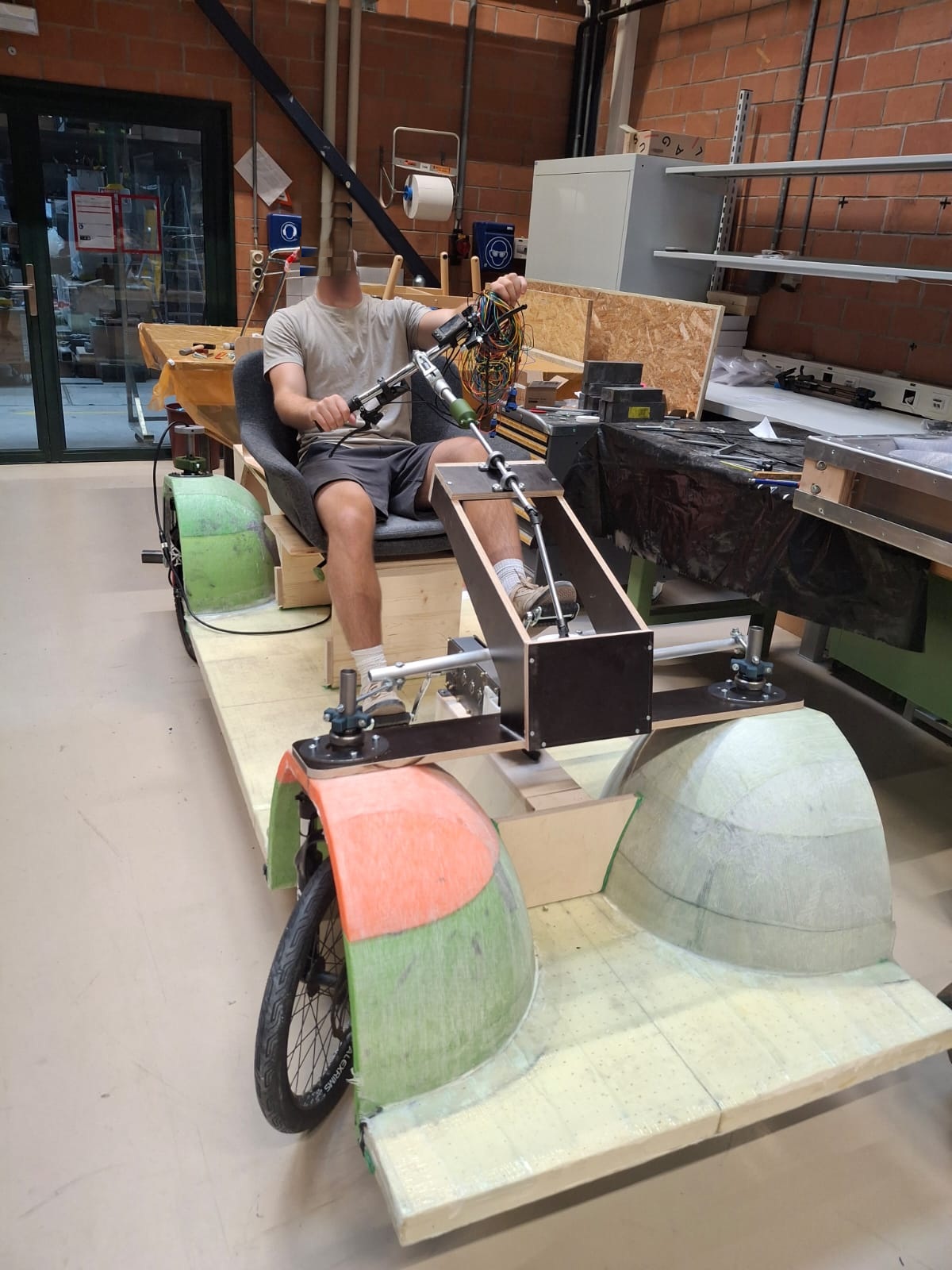
SUV1 finished, in June 2026. Composite plate, four eggshells over the wheels, wooden seat box, pedal assembly in the plywood box ahead of the seat, and a wiring loom still in the open.
The question it was built to answer
Whether a skateboard composite structure at this scale could carry a rider and a drivetrain at acceptable mass.
The answer is no, not as built. The target was 80 kg empty. It came out around 120 kg, and the structure alone (plate plus wheel-attachment shells) accounts for roughly 57 kg of that, about half the vehicle.
Secondarily, and more usefully in hindsight: what does a team need before it can build a vehicle at all? The answer turned out to be most of the modules, which did not exist yet.
What it had to do
The requirements the vehicle was designed against, and which still govern the next one:
| Gross mass supported | 270 kg (vehicle + occupants + cargo) |
| Empty mass | 80 kg maximum |
| Width | 1 m maximum |
| Structure | Carry the powertrain, survive braking and low-speed manoeuvring loads |
| Occupants | 5th to 95th percentile, 10° seat angle for the driver to get out |
| Weather | Offer protection from it |
| Homologation | None required |
The width and mass limits are what keep the vehicle inside the Swiss light-electric-vehicle and e-bike envelope (LCR, OETV, OCR), and that segment’s main practical advantage at this stage is that nothing needs to be homologated. We do not claim compliance as the prototype was never certified against anything but design decisions are meant to stay compatible in principle, because losing that property would cost us years and a lot of money we dont have to homologate a prototype.
Why composite
Honestly: because the vehicle was built through a composites course (CIVIL-464), and the coursework required a composite structure.
That is worth stating plainly rather than reverse-engineering a design rationale. It was a real constraint that produced real learning, and it is not the constraint we would choose. Making It Viable argues for commodity materials and capital-light production, and a hand-laid foam-and-glass structure is neither cheap to reproduce nor easy to repair at the roadside. A production vehicle would not be built this way.
The material also came from the constraint: the fibre, foam and resin were leftovers from earlier lab projects, donated rather than bought. That made the build possible and made its provenance unrecoverable — see what we cannot tell you below.
What it is
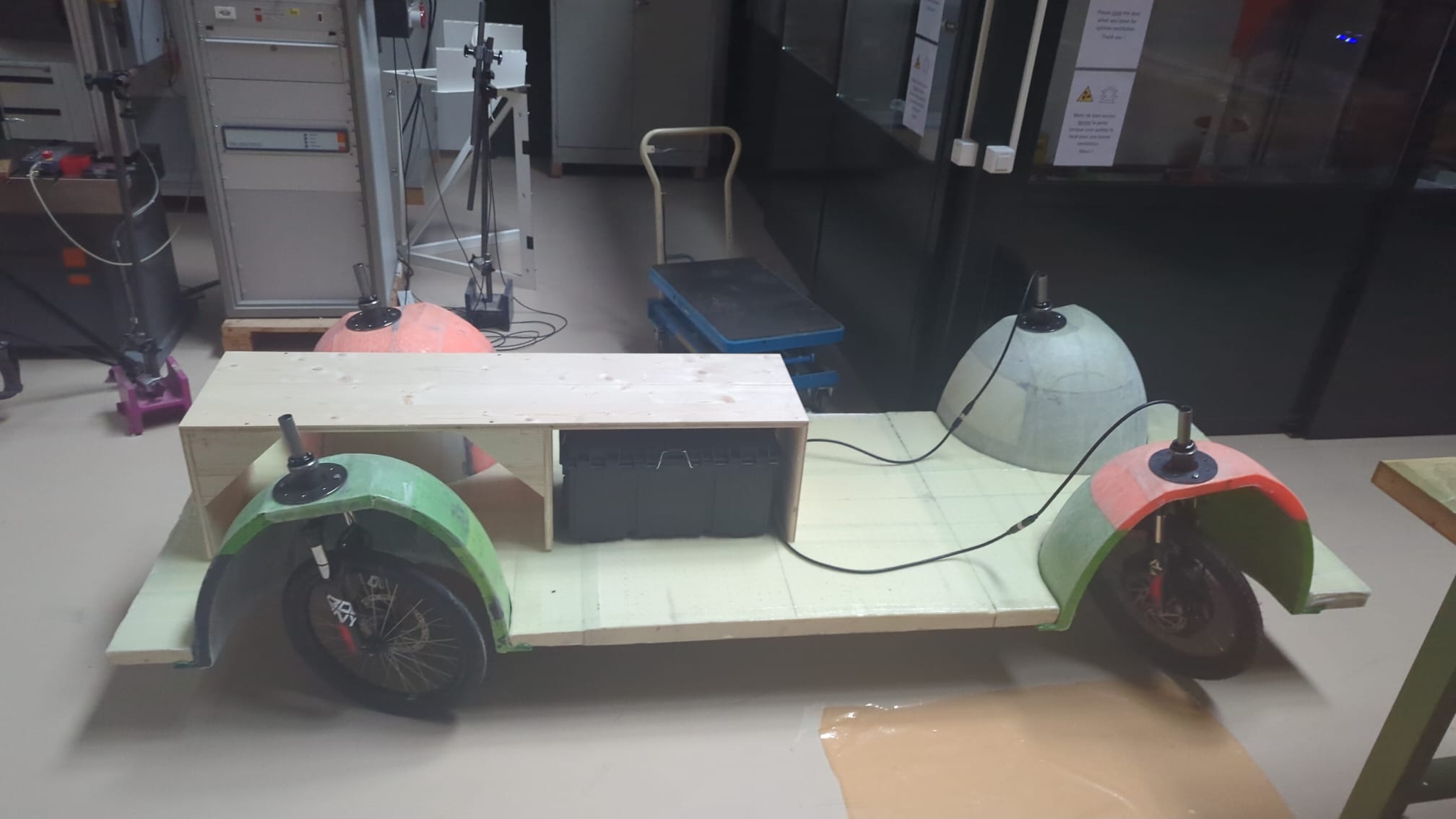
The rolling chassis before the seat and steering went on. The plate is one flat sandwich panel; each eggshell carries a fork on a steel hardpoint at its crown; the battery lives in the black tool box under the wooden seat box.
| Architecture | Composite sandwich plate + 4 “eggshells” bolting the forks to the plate |
| Plate core | PUR foam, 100 kg/m³ (E_c 60 MPa, ultimate shear 0.3 MPa) |
| Plate skins | UD glass fibre, 1200 g/m², 1 mm ply (E₁ 35 GPa, UTS 879 MPa along the fibre) |
| Plate process | Vacuum resin infusion, room-temperature cure |
| Plate size | 300 × 100 cm as built |
| Eggshells | 3D-printed PETG core at 5% infill, wet-layup glass skins, steel fork hardpoint, oven post-cure |
| Joints | Epoxy bond, thixotroped epoxy fill, ±45° glass bands over-laminated at the junctions |
| Body / seating | 19 mm wood battery-and-seat box, salvaged car seat rails |
| Wheels | 4 × 20 inch, two driven |
| Motors | 2 × FH212 hub motor, 250 W nominal each |
| Battery | 15S3P LFP, EVE 20 Ah cells — 48 V, 60 Ah, 2.88 kWh, in an off-the-shelf tool box |
| Controllers | Generic off-the-shelf motor drivers |
| Pedals | DIY pedal generator with a bougth pedal gearbox, resulting in no chain and no mechanical path to the wheel |
| Brakes | Mechanical bicycle disc brakes, four corners, cable-operated |
| Steering | Mechanical, cardan based, ~9 kg including handlebar |
| Mass | ~120 kg complete against an 80 kg target |
| Cost | 1,849 CHF of bought powertrain and running gear; structural materials donated |
| Kilometres driven | ~1 |
| By outside riders | 0 |
Mass, by part
| Component | Mass | Share of as-built |
|---|---|---|
| 4 eggshells | 29.6 kg (7.4 kg each) | 25% |
| Main chassis plate | 27 kg | 22% |
| Wooden box + seats | 20–30 kg (estimated) | ~20% |
| Battery, box included | 20 kg | 17% |
| 2 hub motors | 12.4 kg | 10% |
| 4 forks | 8.8 kg | 7% |
| Steering | ~9 kg | 7% |
| 2 undriven wheels | 4 kg | 3% |
| Brakes, drivers, cables, charger | ~3 kg | 3% |
| Pedal generator | 5–8 kg | 5% |
| Total | ~120 kg |
Shares are against the as-built ~120 kg. The plate alone is 34% of the mass the whole vehicle was supposed to weigh.
What we learned
Mass is not distributed where a car-shaped intuition puts it. The battery and motors together are 32 kg, thats only a quarter of the vehicle. The structure is 57 kg. On a vehicle this small, the frame and its brackets are the mass problem, not the powertrain.
The eggshells cost more than they look like they should. They do three jobs at once: structural node, fork mount, mudguard and at 7.4 kg each, with a kilogram of steel hardpoint inside, four of them outweigh the plate they attach to. Combining functions into one part felt efficient but the implementation need refinement.
Resin fraction dominated the plate CO2 impact. 9 kg of fibre, 9 kg of foam, and 9 kg of resin. A third of the primary structure is matrix, which is the signature of infusing a large flat part with drilled flow holes. Some weight and material reduction is easy here.
“Barely rolling” is a systems statement, not a structural one. The chassis is way more sturdier than it need to be. What stopped it being a usable vehicle was the steering, the missing enclusure around it, the ergonomics and the lightning. For the steering, the issue was rooted in poor engineering that introduced a massive ammount of backlash when steering which made the vehicle hard to control.
What we cannot tell you
We wanted a life-cycle assessment of our own vehicle but it would not make much sense without an expected life. Plus we would be missing a lot of data as a lot of material was donated from leftover of unknown origin. If we made in volume, we would likely have found a much different way to do it which might not be comparable to the impact of this prototype.
- Motors: FH212 hub motors, bought second-hand-channel in Neuchâtel, brought to Lausanne by train. Supplied from Canada (Grin), most likely manufactured in China (9 Continent). How they travelled China → Canada → Neuchâtel is unknown.
- Cells: EVE LFP, made most likely in China, shipped to the Netherlands, posted to Switzerland.
- Composite materials: lab leftovers from earlier projects. Supplier, batch, and transport unknown. They were not bought for this vehicle, which is good for its footprint and fatal for its accounting.
- Enclosure: a tool box from Hornbach Valais, origin unknown, carried back to Lausanne by some mix of train and car.
- The rest: forks, brake calipers, brake levers, motor drivers, charger, motor cables and the pedal generator were bought on AliExpress and appear to ship from China.
What it produced
The most durable output of SUV1 is not the vehicle. It is the realisation that a chassis is the easy part, and that the project was blocked on components nobody sells.
That is the origin of Chapter 7 and of most of the modules: the corner module exists so the next chassis does not have to solve suspension and drive again; steer-by-wire exists so it does not have to solve steering geometry either. The battery pack founding principle turned out sound but it turned out too heavy to be convenient for the trials. The generic motor drivers it rolled on are precisely what open FOC firmware exists to replace: they turned the motors forward, and thats about it, they where not intended for this scenario and as much as they work, they are lacking in finish.
Judged as a vehicle, SUV1 is a poor one. Judged as a research instrument, it did its job: it told us what to build, and it made the case for building modules before vehicles.
Open questions it left behind
- Should the vehicle tilt in corners, and what does that do to a flat-plate chassis?
- Can a body that actually protects from weather be added without spending the mass budget twice?
- What passive safety, if any, belongs in the next iteration?
- How much pedalling does regulatory compliance actually require, and how much can a rider stand?
Interested in any of these? Come talk to us.
How it was built
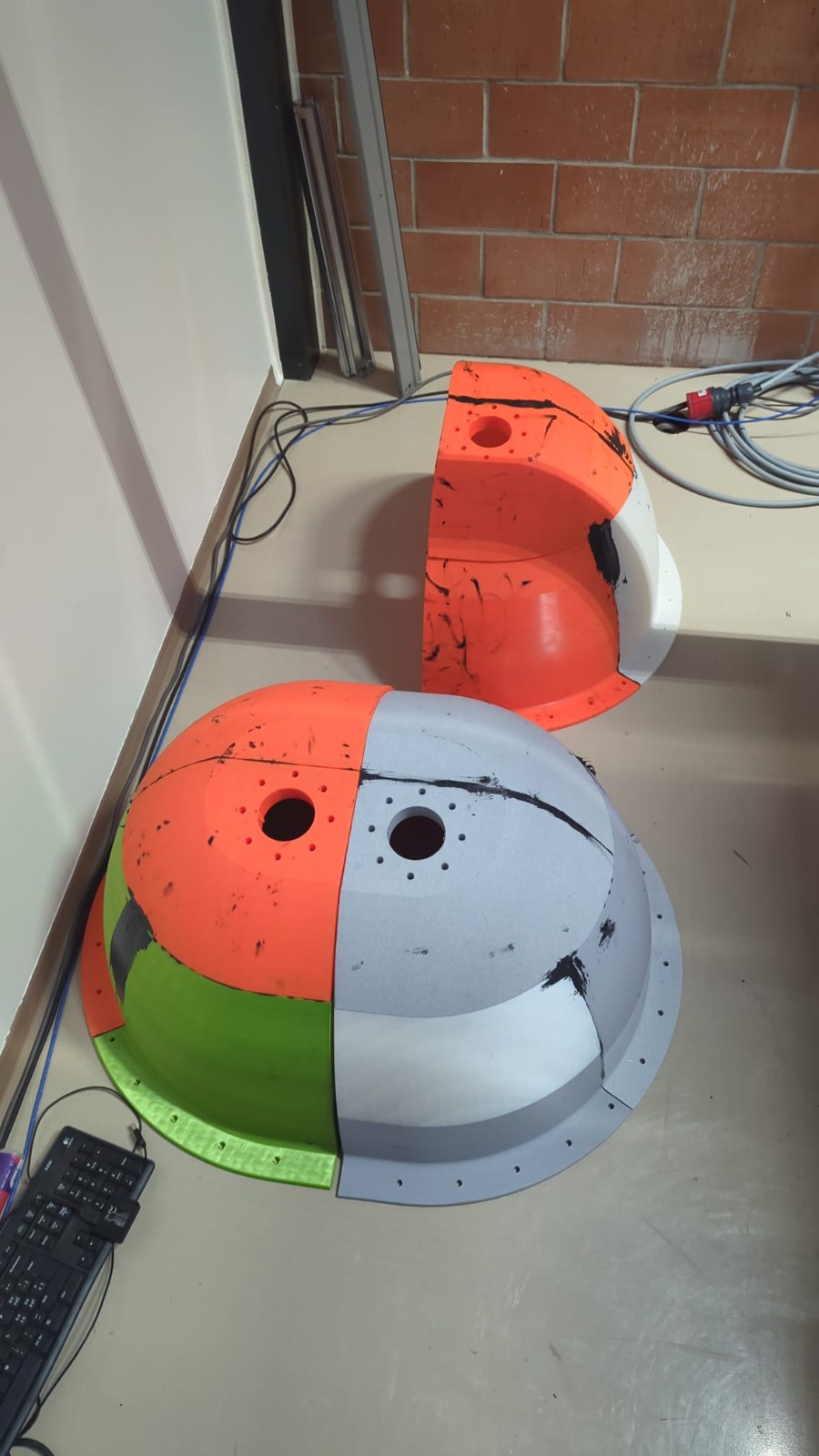
Eggshell cores, printed in PETG at 5% infill in segments and bonded together, before any glass went on. The bolt circle at the base is the interface to the plate; the crown takes the steel fork hardpoint.
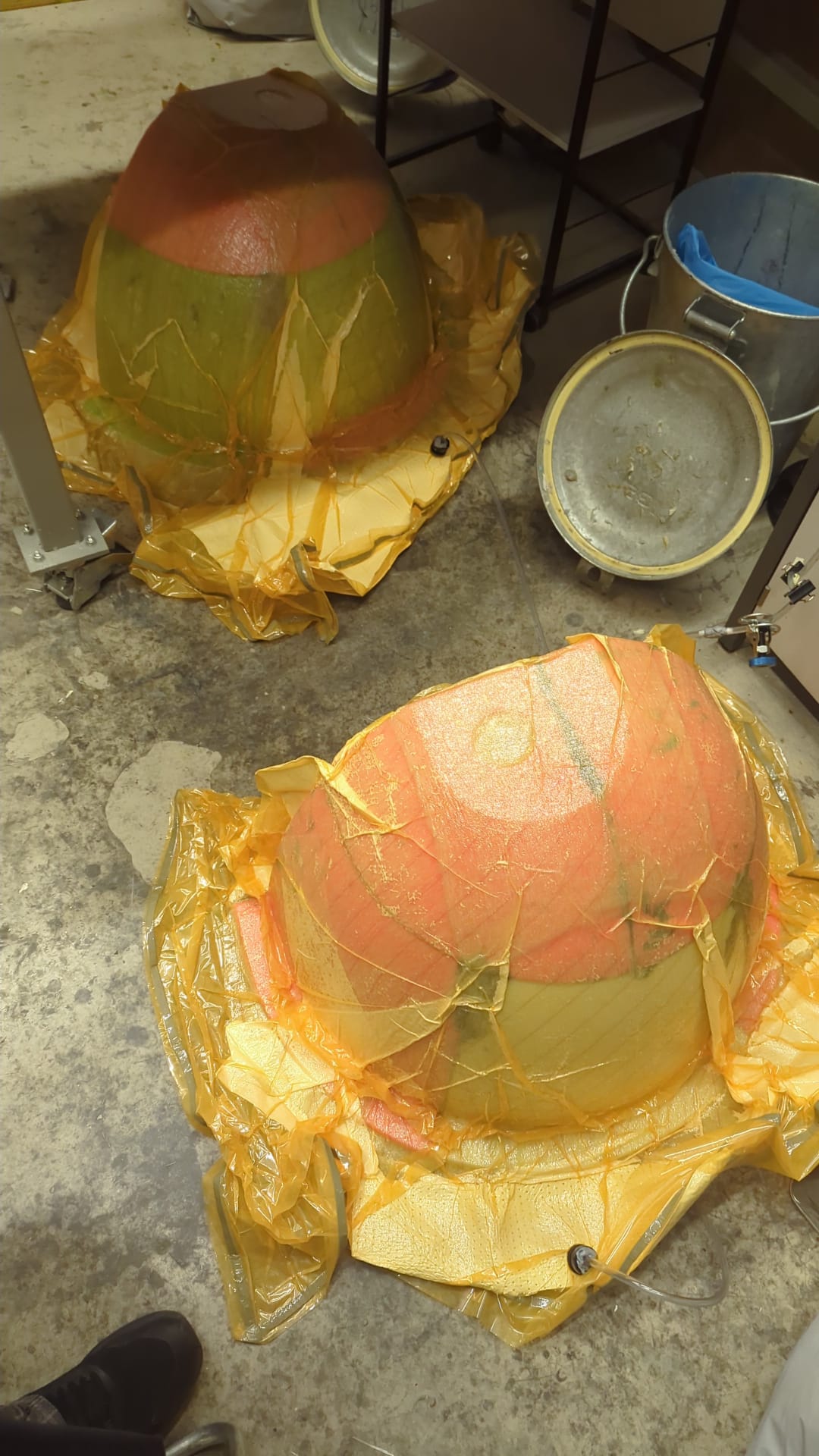
Wet-laid glass skins curing under vacuum, one eggshell at a time. Each shell was bagged that way.
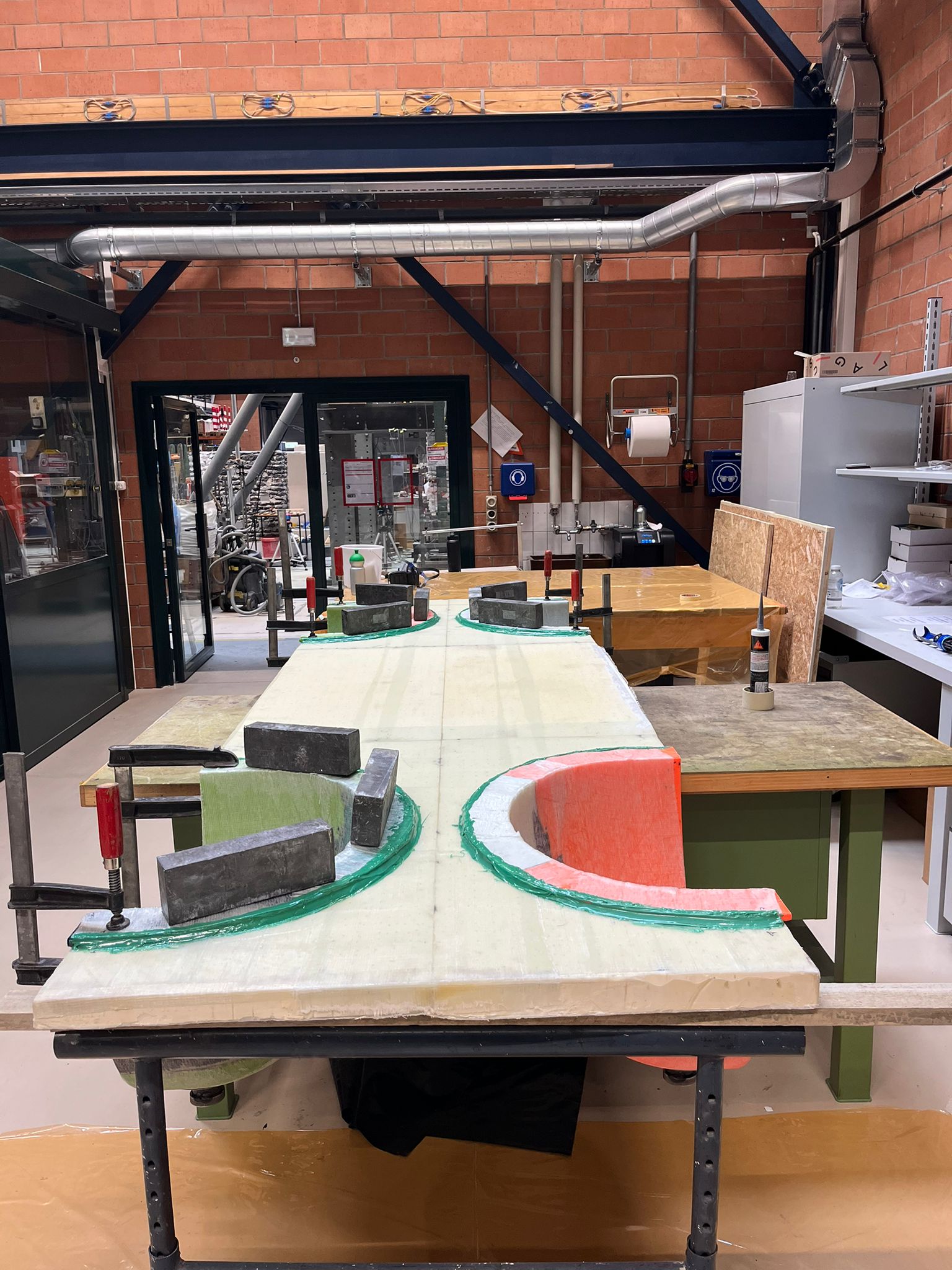
Bonding the eggshells into the plate: thixotroped epoxy fillets, lead weights and clamps for pressure, then ±45° glass bands over-laminated across each junction.